|
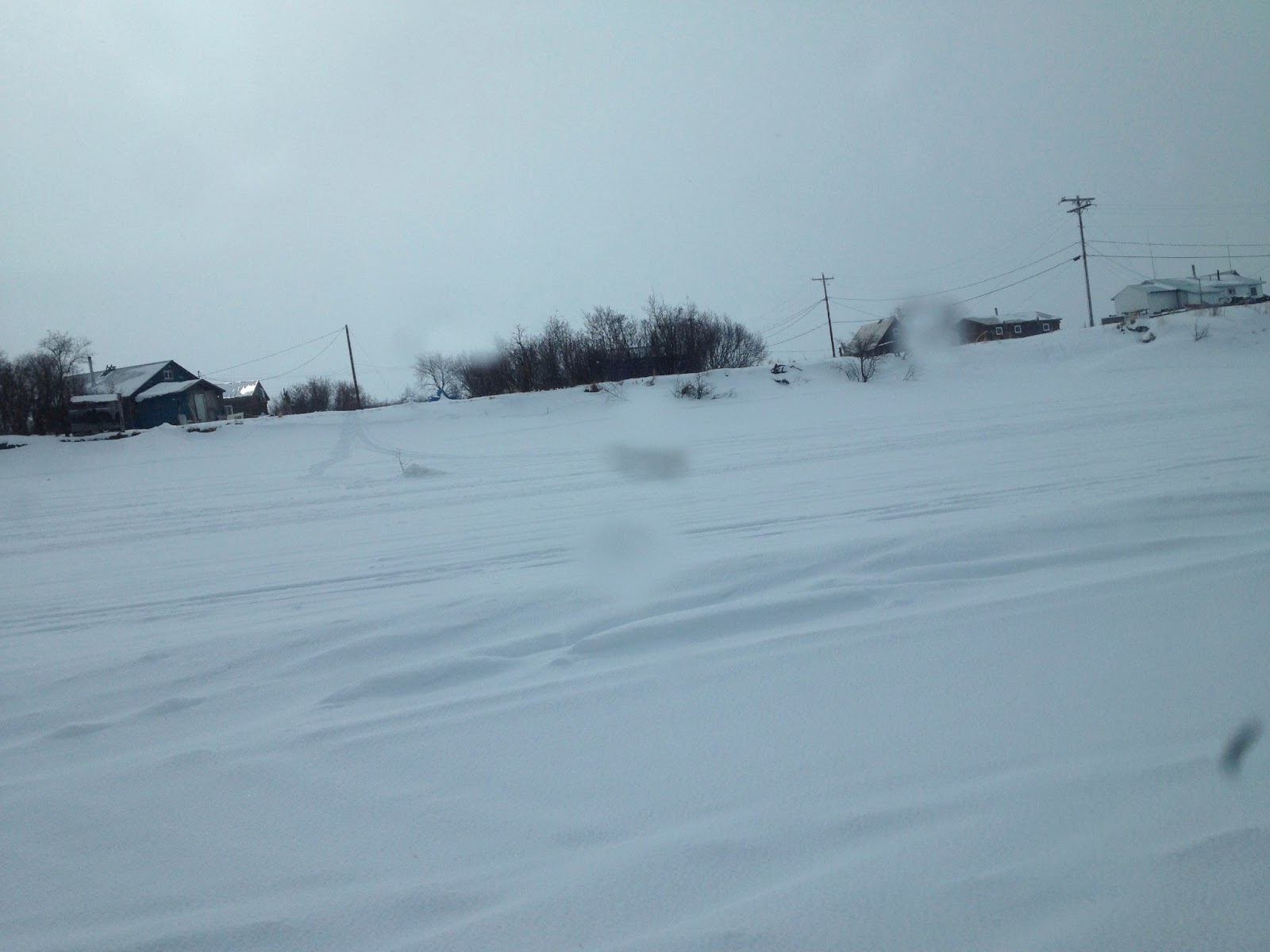
| A road with ice... |
I've been in Alaska all this week, conducting test administration fidelity observations of our assessment for kids with severe cognitive delays. Four days in Anchorage (where it has been snowing all week), one day in a tiny village, Kwethluk which is home to 153 families. I visited the school, a building about half again as large as my house, which contained all ages of kids, kindergarten through twelfth. The kids were lovely, primarily of the Yup'ik tribe.
A sign on the front entry bulletin board declared a unanimous vote of the school board to cancel school on any day where the temperature was -40 degrees, or the windchill and temperature reached -65 degrees. Good to know. Kids, don't forget your mittens...
I worked all day with the teacher who works with kids who have severe disabilities. She was very nice, had been nervous about my visit for more than a month. I practiced the reading test with her before she administered the test to a student. The child was very cooperative and friendly, seemed to enjoy the extra attention (me), and did pretty well on the test.
After the reading test, I spent another hour with her on the writing test, and wrote out fake student responses for her to practice scoring. I spent the entire day in her classroom.
The Adventures of Rural Alaska Travels: The flight to the village started with a 6:40 AM flight from Anchorage to Bethel, and then a transfer to a single propeller little plane that seated 6 passengers and room for cargo. For my 8:30 AM flight, I shared the plane with the pilot and co-pilot (I called shotgun, but was outvoted) and a clothes dryer and freezer in their shipping boxes, destined to Aniak, another little village. We were headed to Kwethluk (my destination), but detoured to offload the cargo in Aniak, because there were 5 people waiting to board in Kwethluk, but they wouldn’t be able to get to the chairs with the cargo still on board.
The “airport” in Kwethluk is a landing strip and a tin shed, a little larger than a barn. Not sure what is inside, but it isn’t a waiting room. The system is: the “agent” at the village meets the plane and drives the passenger/s to the village. Passengers leave their contact and return flight information with the agent, and he or she calls to tell you if the plane is arriving on time, late, or not flying at all (“weathered in”). If the flight is going to happen, the agent comes and picks you up to get you to the airport. You don’t want to go early, because you can’t get inside, and it is pretty cold outside. My return flight to Bethel was scheduled for 1:30, so I was to call at 1:15 if I hadn’t been contacted.
At 1:15 we discovered the planes were “weathered in” and not going to pick me up to take me from Kwethluk to Bethel. My flight from Bethel to Anchorage was scheduled to leave at 8:45 PM. So I needed a way to get to Bethel, about 50 miles away.
Finding Plan B: Apparently, the teachers and teacher aides in the class all felt a great protectiveness of me, and wanted to be sure I made it to Bethel for my flight. So three different people got on their cell phones and started calling around to discover if anybody from the village was going to drive “the ice road” to Bethel that afternoon. At first it was looking like that wasn’t going to work out, so then they started devising . . .
Plan C: Plan C was to ride on the back of a snowmobile to Bethel. Two snowmobiles would go, so that we’d all be safe (not sure what that means, or why two is safer than one, but they seemed pretty sure about the two snowmobiles being the minimum). I was hoping that we would be stuck with Plan C. But the snowmobilers wouldn’t be able to leave school until 5:00, so the Cell phone ladies got to work again, and finally located Myrna, who was headed to Bethel around 3:00 and had one more seat in her car.
 |
| The Ice Road |
Did I mention that the “Ice Road” is the frozen Kuskokwim River? The river freezes in October, and starts to thaw in late April. The ice is currently about 6 feet thick.
I rode in a car on a river yesterday.
The rest of the travel was uneventful. A long wait in Bethel, short flight to Anchorage, finally back to my hotel room after another 20 hour work day...
Willamette University College of Law is willing to take a chance on me as a member of their student body. There is a letter waiting for me in my PO Box, hopefully with details of scholarships and financial aid offers. Willamette is nearly twice the cost of UO, so...
Still waiting to hear from UO.
But, well, I feel pretty proud that Willamette would like me to join them.
Hotzi Anu, hotzi anu mi mitzraim, hotzi anu mi mitzraim day-enu!
I am in Anchorage all this week, working with our academic assessment for kids with severe cognitive delays.
This week is Passover.
What's a girl to do?
Well, of course, attend the Anchorage Congregation Beth Sholom (frozenchosen.org) community seder. One of the cool things about belonging to a tradition is knowing that all around the world (with adjustments for time zones), Jews are sitting down to a very similar celebration.
A serene experience of belongingness.
Surrounded by strangers.
...with Love.
I have discovered that my google blog has some very fun tools for analyzing my audience. Number of page views by date, number of followers, type of computer and browser, etc.
I recently had a day with 21 page views. Twenty One? Wow, I wondered where my audience lived.
Mostly in Russia, apparently.
This is my monitor.
This is my heart on a monitor.
Any Questions?
Spoiler Alert: I am fine.
I thought I was having a heart attack driving home yesterday, pulled into the
W 11th Urgent Care, they sent me to RiverBend ER. By then, I was feeling fine and reached for my keys to drive the 12 miles to RiverBend, and... No. I was told to get a friend to drive me or they'd get an ambulance. I'm not great at asking for help, but I was mortified to think I'd have to ride in an ambulance when someone else might really need that. So I called my tenant Josée and she kindly acted as chauffeur for me. I thought it would be two hours or so. Wrong.
Five hours of waiting
around and there was no heart attack or heart problems, they don't know
what it was.
Did you know that a blood test can diagnose if you have had a heart attack? Cool magic trick... a heart releases two enzymes depending on the damage done to it, so the blood test looks for elevated levels of the two enzymes.
I also learned that I can think my heart rate to 85 bpm, and then quickly think it down to its normal 65. That was fun: several hours of messing with my heart beat and watching the green number go up and down. The lowest I was able to go was 58.
Also, if you wiggle frantically while connected to a monitor, you can make your heartbeat set off alarms. Which brought a stern scolding from the medic.
You know me, I don't do "Wait quietly" well... Anyway, I felt like I lost an entire day, and don't even know what for.
My self-prescribed medication: Drink some water.
And do things that release oxytocin and endorphins. You know. Exercise and stuff. And meditate.
Or maybe the bag before the books??
My trusty leather tote/briefbag disintegrated on my trip to California last week. That's fair, it is at least 20 years old, so fully amortized.
So, knowing I would need a nice looking, sturdy, and functional replacement for law school (*), I have replaced it.
(*) Even if I don't go to Law School, I will want a nice bag for future meetings with faculty and staff at the MIND Institute of UC Davis... And a pretty place in which to tote tools and data for the COAST research. The clothes may make the man, but the bag makes the researcher...
 In November, Sidney and I gathered our collective chutzpah and sent a letter to Dr. David Amaral, the research director of the MIND Institute, UC Davis. The mission statement of the MIND Institute is "To find effective treatments and cures for autism and other neurodevelopmental disorders." The MIND Institute is a premier research contributor in the causes of, diagnosis, and treatment of Autism. We thought that our COAST might play a role in their mission... as a baseline measurement of the impact of autism on a particular child, and as a stable measure of growth over time.
So we sent a letter with 3 attachments: the 2-page spread of Domain 1: Social Relationships, a description of all 12 domains, and a description of all 7 levels of severity.
The MIND Institute sponsors a Distinguished Lecture series, and Catherine Lord was to be the guest of honor on February 13. Sidney and I wanted to attend Dr. Lord's lecture, so we asked Dr. Amaral if we could meet him when we were in town for the Lecture.
He responded, "Yes." (this despite the fact that we spelled his last name incorrectly in the letter! An error for which I later apologized). He offered us an hour on the 13th. An hour is a very generous offer of time.
Our greatest hopes were that 1) he would find some value in the COAST and 2) might, at some later date, suggest a doctoral student who might be interested in using the COAST in a dissertation or other research project.
So, how did the meeting go?
After some reflection, here's my assessment: Wow! What a great day!
We presented Dr. Amaral with two complete packets of
the COAST (Evaluator Manual, Full Scale, Core Four Screening tool and
Supplemental Eight Module). The first thing he complimented was the
professional quality of the production of the tools, "beautiful
presentation," he said. Then he asked some good questions, starting with How did we come to creating this tool, and moving to questions about our plans for the tool and whether we thought the COAST might replace other existing tools. He invited in his colleague, Dr. Peter
Mundy. Peter Mundy is the director of educational research and heads up a research lab. His
teams are already involved in a research study and he promised to share
the tool
with them, and see if there is a way to fold the COAST into research
they are already doing. I got the impression that, if their current
research could not accommodate the COAST as added research, that they
would find a way in the near future to write it into grants and work
they are doing. Almost under his breath, Dr. Mundy said, as he leafed
through the Full Scale Module, "There's nothing out there like this."
Dr. Amaral said lots of very nice things
about where he thought the tool would be useful. Then he spent time
coaching us on the people we needed to talk to, how to "market" the
tool, and perhaps that we might just go approach some publishing
companies for assistance in getting the data we need to publish the
tool.
Then
we went to hear Dr. Catherine Lord speak about research she is doing.
She is a Really Big Name in autism research. After her talk, Sidney and I
were preparing to leave, and David Amaral invited us to dinner with his
team and Catherine Lord.
Amazing. Beyond our wildest dreams.
In the world of Autism research, Sidney and I are like students of guitar, just beginning to pick out some complicated songs and melodies of our own invention... and we attend an Eric Clapton concert and Eric Clapton hears our melody and invites us to dinner and offers to help us with our guitar technique. That is the difference in stature between David Amaral's body of research and our own. He is an incredibly generous man.
I have a list of "next steps" to implement, and people with whom we should speak. The journey continues.